NAVIGENTIA™ · Human Judgment in the Age of AI
AI won't replace you because it can do more.L'AI non ti sostituirà perché sa fare di più.
The real risk is losing sight of what is worth doing.Il rischio è smettere di capire cosa vale la pena fare.
Every day artificial intelligence gets faster at producing, analysing, predicting and optimizing. But speed is not direction.Ogni giorno l'intelligenza artificiale diventa più veloce nel produrre, analizzare, prevedere e ottimizzare. Ma velocità non significa direzione.
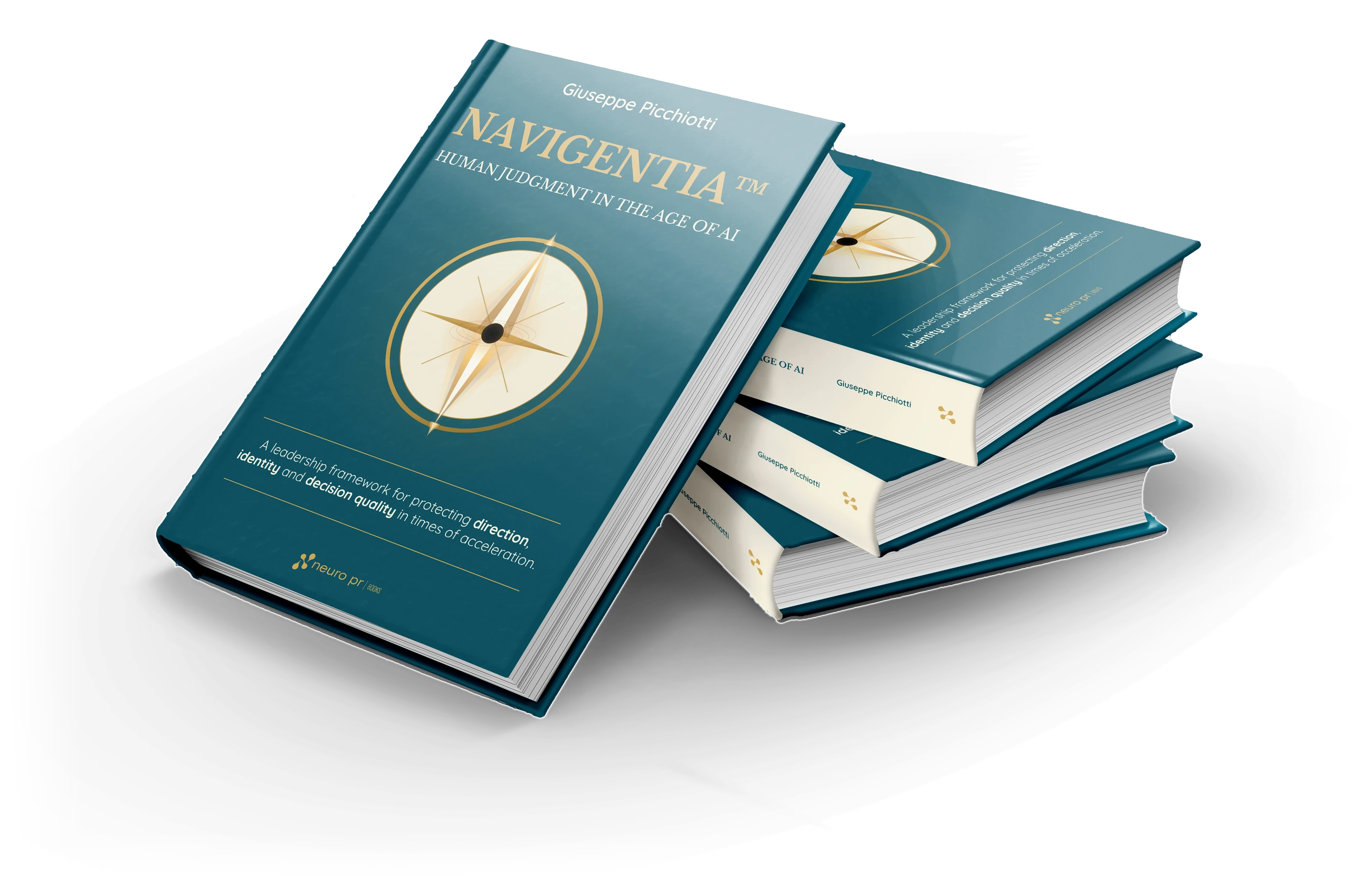
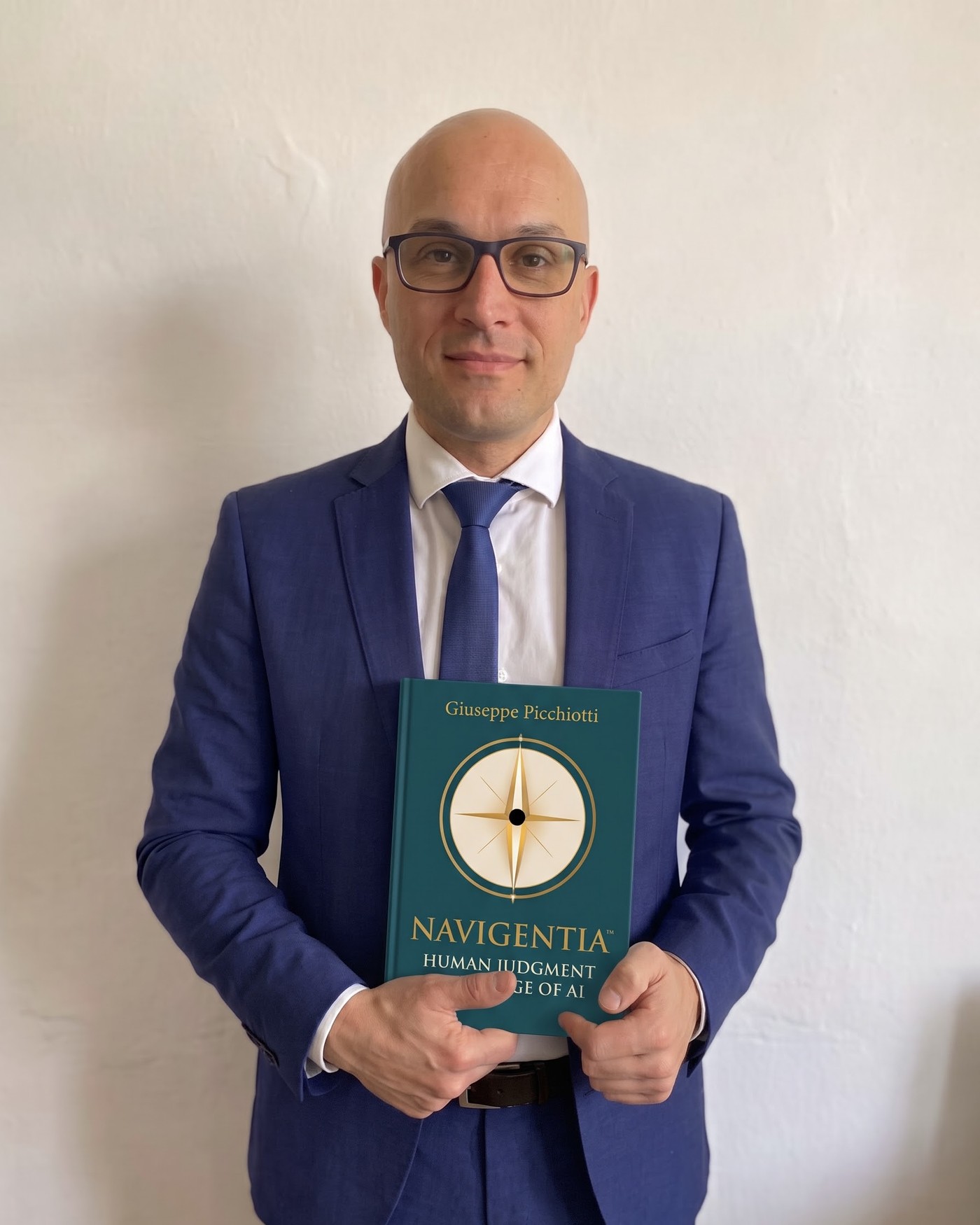
NAVIGENTIA™ is the book by Giuseppe Picchiotti for leaders, managers, founders and professionals who want to use artificial intelligence without handing it what must stay human: judgment, responsibility, identity and the choice of direction.NAVIGENTIA™ è il libro di Giuseppe Picchiotti dedicato a leader, manager, imprenditori e professionisti che vogliono utilizzare l'intelligenza artificiale senza delegarle ciò che dovrebbe rimanere profondamente umano: giudizio, responsabilità, identità e capacità di scegliere la rotta.
AI accelerates output.
Leadership protects outcomes.
NAVIGENTIA™ restores direction.
Not another prompt manual. A method for deciding better in the age of AI.Non un altro manuale di prompt. Un metodo per decidere meglio nell'era dell'AI.
The new risk is not having too little information. It is mistaking motion for progress.Il nuovo rischio non è avere poche informazioni. È confondere movimento con progresso.
You probably don't need to learn to use AI better. You already have the tools.Probabilmente non hai bisogno di imparare a usare meglio l'AI. Hai già accesso agli strumenti.
Yet the most important problem is emerging right now: the more answers are available, the harder it is to know which questions deserve to be asked.Eppure il problema più importante sta emergendo proprio adesso: più aumenta la quantità di risposte disponibili, più diventa difficile capire quali domande meritano di essere poste.
AI can help you find a solution, work it out faster and compare alternatives a person would need days to analyse. But one question remains that no amount of computing power removes.L'AI può aiutarti a trovare una soluzione, elaborarla più velocemente e confrontare alternative che una persona impiegherebbe giorni ad analizzare. Ma rimane una domanda che nessun aumento della capacità computazionale elimina.
Modern organizations are becoming extraordinarily efficient: they produce more content, process more data, automate more processes and track more KPIs than ever.Le organizzazioni moderne stanno diventando straordinariamente efficienti: producono più contenuti, elaborano più dati, automatizzano più processi, misurano più KPI.
Yet a system can become extremely efficient at going the wrong way. A team can hit every target and lose sight of its purpose. A manager can have every data point and not know which one really matters. A professional can use AI every day and gradually hand over not only the execution, but also the ability to think.Eppure un sistema può diventare estremamente efficiente nell'andare nella direzione sbagliata. Un team può raggiungere ogni indicatore e aver perso di vista lo scopo. Un manager può disporre di ogni dato e non sapere quale sia realmente importante. Un professionista può utilizzare l'AI ogni giorno e progressivamente delegarle non soltanto l'esecuzione, ma anche la propria capacità di pensare.
Are we solving the right problem?Stiamo risolvendo il problema giusto?
This is the paradox of acceleration: when everything moves faster, stopping long enough to understand where we are going becomes a competitive skill. This is where NAVIGENTIA™ begins.Questo è il paradosso dell'accelerazione: quando tutto diventa più veloce, fermarsi abbastanza a lungo da capire dove stiamo andando diventa una competenza competitiva. È qui che comincia NAVIGENTIA™.Artificial intelligence is not the problem. It is an amplifier.L'intelligenza artificiale non è il problema. È un amplificatore.
A technology does not decide who we become. It amplifies what it finds.Una tecnologia non decide chi dobbiamo diventare. Amplifica ciò che trova.
It is one of the central ideas of NAVIGENTIA™: technology increases our ability to act, but it cannot decide on its own which ends are worth pursuing. AI can accelerate execution. Direction remains a human responsibility.È una delle tesi centrali di NAVIGENTIA™: la tecnologia aumenta la nostra capacità di fare, ma non può definire autonomamente quali fini meritino di essere perseguiti. L'AI può accelerare l'esecuzione. La direzione rimane una responsabilità umana.
AI is the new fire.L'AI è il nuovo fuoco.
Prometheus gave fire to humanity, and with it possibilities that had not existed before: to build, transform, protect and create. The same fire could also destroy. The problem was never owning it. It was learning to govern it.Prometeo consegnò all'uomo il fuoco. Con esso arrivarono possibilità che prima non esistevano: costruire, trasformare, proteggere, creare. Ma lo stesso fuoco poteva distruggere. Il problema non era possederlo. Era imparare a governarlo.
Artificial intelligence is a new form of power. It extends not only the body: it extends the operating mind, increasing our ability to analyse, predict, produce and act. More power demands more judgment.L'intelligenza artificiale rappresenta una nuova forma di potere. Non estende soltanto il corpo: estende la mente operativa. Aumenta la nostra capacità di analizzare, prevedere, produrre e intervenire. Ma maggiore potere richiede maggiore giudizio.
The question is not only what you will do with AI. It is who you will become while using it.La questione non è soltanto cosa farai con l'AI. È chi diventerai mentre la utilizzi.
Every technology changes the person who uses it. Writing changed memory. The internet changed our relationship with information and distance. Artificial intelligence is starting to change how we think, create, learn and decide. That is why NAVIGENTIA™ deals not only with productivity, but with identity, presence, responsibility and direction.Ogni tecnologia modifica l'essere umano che la utilizza. La scrittura ha modificato la memoria. Internet ha modificato il nostro rapporto con informazione e distanza. L'intelligenza artificiale sta iniziando a modificare il rapporto con pensiero, creatività, apprendimento e decisione. Per questo NAVIGENTIA™ non affronta soltanto la produttività, ma identità, presenza, responsabilità e direzione.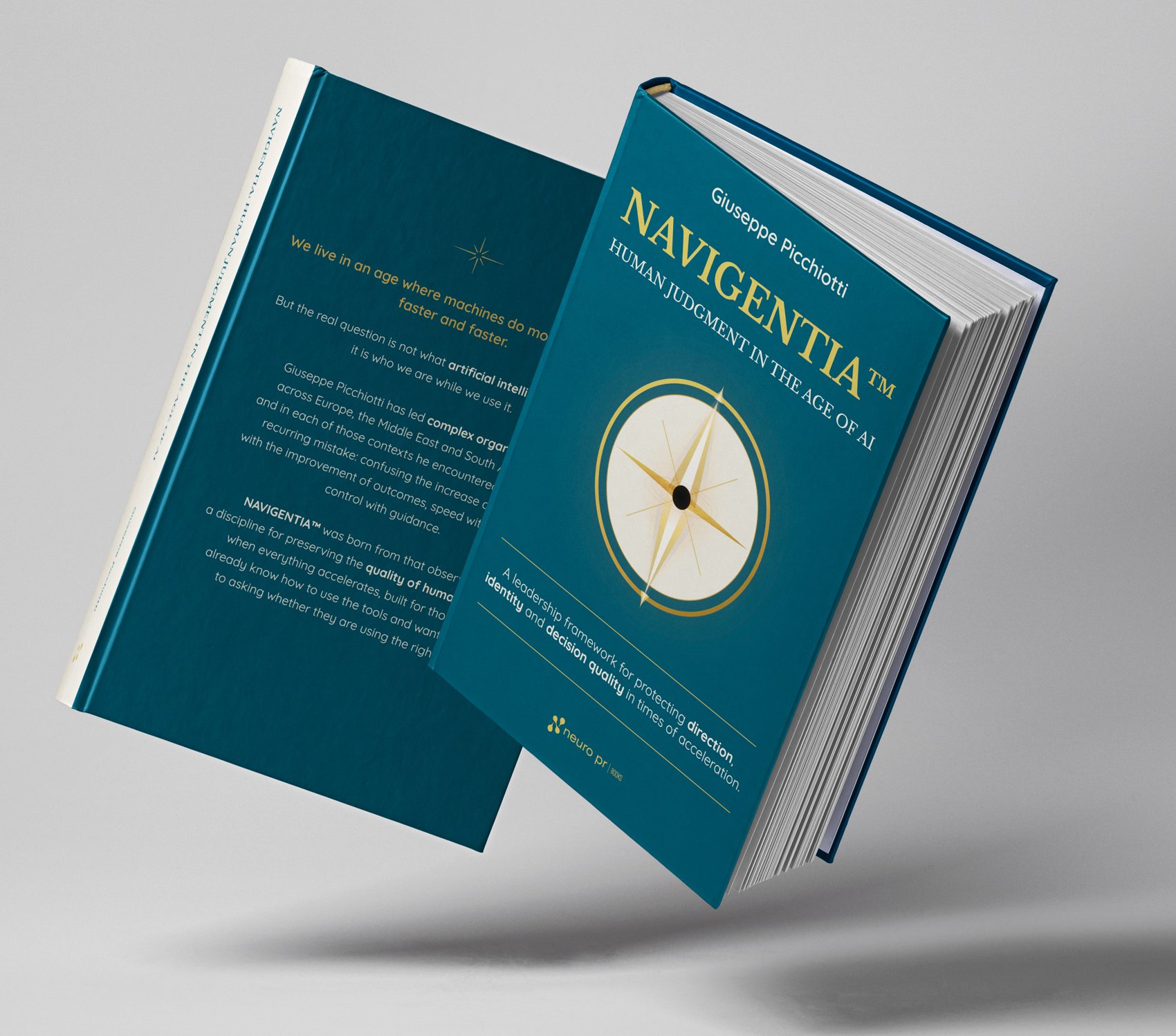 English editionEdizione inglese
NAVIGENTIA™
Human Judgment in the Age of AI
A Leadership Framework for Protecting Direction, Identity and Decision Quality in Times of Acceleration
NAVIGENTIA™ was written to face one of the defining questions of the new leadership: how to protect the quality of decisions when technology, information and pressure all accelerate at once.NAVIGENTIA™ nasce per affrontare una delle questioni decisive della nuova leadership: come preservare la qualità delle decisioni quando tecnologia, informazioni e pressione accelerano contemporaneamente.
It is not a book against artificial intelligence. Nor is it a book that treats it as a universal solution. It is a discipline for using it without losing your own decision-making centre: a framework that brings together leadership, systems thinking, philosophy, technology and decision making.Non è un libro contro l'intelligenza artificiale. E non è un libro che la considera una soluzione universale. È una disciplina per imparare a utilizzarla senza perdere il proprio centro decisionale: un framework che integra leadership, pensiero sistemico, filosofia, tecnologia e decision making.
What must stay human when everything moves faster?Cosa deve rimanere umano quando tutto diventa più veloce?
Buy NAVIGENTIA™Acquista NAVIGENTIA™Four phases. One responsibility: holding the course.Quattro fasi. Una sola responsabilità: mantenere la rotta.
NAVIGENTIA™ turns a complex reflection into four operating disciplines.NAVIGENTIA™ traduce una riflessione complessa in quattro discipline operative.
READ
System Reading
Read the system before acting. Not only the visible problem, but relationships, incentives, tensions, feedback and consequences. What looks like the problem is often just the point where the system is showing something deeper.Prima di intervenire, comprendi ciò che stai realmente osservando. Non soltanto il problema visibile, ma relazioni, incentivi, tensioni, feedback e conseguenze. Spesso ciò che appare come il problema è soltanto il punto in cui il sistema sta mostrando qualcosa di più profondo.
CLARIFY
Telos Clarification
Before optimizing a process, ask what it should produce. Before increasing speed, define the destination. When the end stays implicit, efficiency becomes a sophisticated way of drifting.Prima di ottimizzare un processo, chiediti cosa dovrebbe produrre. Prima di aumentare la velocità, definisci la destinazione. Quando il fine rimane implicito, l'efficienza può diventare una forma sofisticata di dispersione.
JUDGE
Deliberate Judgment
Data can inform a decision. It cannot take responsibility for it. Judgment means bringing together information, context, consequences, values and goals to choose even when no mathematically perfect answer exists.I dati possono illuminare una decisione. Non possono assumerne la responsabilità. Giudicare significa integrare informazioni, contesto, conseguenze, valori e obiettivi per scegliere anche quando non esiste una risposta matematicamente perfetta.
REALIGN
Adaptive Coherence
Systems change, conditions change. Strategies must be able to change without losing the axis. Navigating does not mean following a fixed plan: it means correcting the course continuously without forgetting the destination.I sistemi cambiano, le condizioni cambiano. Le strategie devono poter cambiare senza perdere l'asse. Navigare non significa seguire un piano immutabile: significa correggere continuamente la traiettoria senza dimenticare la destinazione.
The operating core: read the system, clarify the purpose, exercise judgment and realign the course.Il cuore operativo: leggere il sistema, chiarire il fine, esercitare il giudizio e riallineare la rotta.
AI multiplies output. Leadership protects outcomes.L'AI è straordinaria nell'aumentare l'output. La leadership deve proteggere l'outcome.
This distinction changes everything.Questa distinzione cambia tutto.
What you produceCiò che produci
- A presentation
- A report
- A plan
- A strategy
- An analysis
- A forecast
- Una presentazione
- Un report
- Un piano
- Una strategia
- Un'analisi
- Una previsione
What it should achieveCiò che dovrebbe generare
- A better decision
- A stronger organization
- A customer served better
- A more autonomous team
- A life of higher quality
- Una decisione migliore
- Un'organizzazione più forte
- Un cliente meglio servito
- Un team più autonomo
- Una vita con maggiore qualità
Artificial intelligence makes output less scarce every day. That is why value will move towards understanding which outcomes are worth pursuing. Not more things. Better work on the things that matter.L'intelligenza artificiale rende l'output sempre meno scarso. Per questo il valore si sposterà verso capire quali outcome meritano di essere perseguiti. Non fare più cose. Fare meglio le cose che contano.
It was not written for people who simply want to be more productive.Non è stato scritto per chi vuole semplicemente diventare più produttivo.
It was written for people who feel their role is changing.È stato scritto per chi sente che il proprio ruolo sta cambiando.
- The leader who built real value before AI and now sees the rules change.
- The manager with more information than they can turn into decisions.
- The founder who does not want to confuse innovation with adopting every new tool.
- The professional who uses AI but refuses to become the executor of its answers.
- Anyone who leads people, systems or organizations and knows the future will need people who can use the tools without losing direction.
- Il leader che ha costruito valore prima dell'AI e oggi vede cambiare le regole.
- Il manager che dispone di più informazioni di quanto riesca realmente a trasformare in decisioni.
- L'imprenditore che non vuole confondere innovazione con adozione indiscriminata della tecnologia.
- Il professionista che utilizza l'AI ma non vuole trasformarsi nel semplice esecutore delle sue risposte.
- Chi guida persone, sistemi o organizzazioni e sa che il futuro richiederà persone capaci di utilizzare gli strumenti senza perdere direzione.
Not just ideas. Tools to turn them into behaviour.Non soltanto idee. Strumenti per trasformarle in comportamento.
- Part IParte IThe world that is emergingIl mondo che sta emergendoComplex systems, progress and the consequences of acceleration.Sistemi complessi, progresso e conseguenze dell'accelerazione.
- Part IIParte IIHow to thinkCome pensareAttention, language, identity and judgment, with lessons from the classics.Attenzione, linguaggio, identità e giudizio, con le lezioni dei classici.
- Part IIIParte IIIHow to actCome agireThe operational core of the framework, applied to yourself, others and organizations.Il cuore operativo del framework, applicato a sé, agli altri e alle organizzazioni.
- Part IVParte IVWhere we are goingDove stiamo andandoA long-term view for leaders, teams and society.Una visione di lungo periodo per leader, team e società.
The book applies the method to the individual, to teams and to organizations, with practical tools:Il libro applica il metodo alla persona, ai team e alle organizzazioni, con strumenti pratici:
Before choosing the book.Prima di scegliere il libro.
What language is the book in?
Where can I buy it?
Is it a technical book about AI?
Do I need technical knowledge of AI?
Is it only for managers?
Is the book against AI?
If AI keeps improving, will human judgment still matter?
What is the central idea of NAVIGENTIA™?
In che lingua è il libro?
Dove posso acquistarlo?
È un libro tecnico sull'intelligenza artificiale?
Devo avere competenze tecniche sull'AI?
È pensato soltanto per manager?
È un libro contrario all'intelligenza artificiale?
Se l'AI continuerà a migliorare, il giudizio umano sarà ancora così importante?
Qual è l'idea centrale di NAVIGENTIA™?
Picture two leaders five years from now.Immagina due leader tra cinque anni.
Both use the same tools, have access to the same models, can analyse huge amounts of information and automate most of their operational work.Entrambi utilizzano gli stessi strumenti, hanno accesso agli stessi modelli, possono analizzare enormi quantità di informazioni e automatizzare gran parte del lavoro operativo.
Uses it all to go faster. He has increased his capacity to execute.Utilizza tutto questo per andare più velocemente. Ha aumentato la propria capacità di esecuzione.
Uses it all to see more clearly. He has increased the quality of his direction.Utilizza tutto questo per vedere più chiaramente. Ha aumentato la qualità della propria direzione.
The difference will not be the technology they use. It will be the way they think.La differenza non sarà nella tecnologia che utilizzano. Sarà nel modo in cui pensano.
But someone still has to decide: what matters, what to protect, which risk to accept, which result to pursue, when to change course, and above all why the destination is worth reaching.Ma qualcuno deve ancora decidere: cosa conta, cosa proteggere, quale rischio accettare, quale risultato perseguire, quando cambiare rotta, e soprattutto perché vale la pena arrivare a destinazione.
Technology can show you the wind. It cannot choose the horizon.La tecnologia può mostrare il vento. Non può scegliere l'orizzonte.
Don't just learn to use smarter tools. Become clearer about how to use them.Non imparare soltanto a usare strumenti più intelligenti. Diventa più lucido nel decidere come utilizzarli.
NAVIGENTIA™: Human Judgment in the Age of AI does not want to tell you what to think. It offers a discipline for thinking better when speed, complexity and technology make it harder to do so.NAVIGENTIA™: Human Judgment in the Age of AI non vuole dirti cosa pensare. Vuole offrirti una disciplina per pensare meglio quando velocità, complessità e tecnologia rendono più difficile farlo.
To use AI as an extension of your abilities, not a substitute for your responsibility. To gain speed without losing depth. To adapt the course without losing the axis. To keep leading when the tools become powerful enough to create the illusion that the helm is no longer needed.Per utilizzare l'AI come estensione delle tue capacità, non come sostituto della tua responsabilità. Per aumentare la velocità senza perdere profondità. Per adattare la rotta senza perdere l'asse. Per continuare a guidare quando gli strumenti diventano abbastanza potenti da creare l'illusione che il timone non serva più.
The future will not only need people who know how to use artificial intelligence. It will need people who know where to take it.Il futuro non avrà bisogno soltanto di persone che sappiano utilizzare l'intelligenza artificiale. Avrà bisogno di persone che sappiano dove portarla.
Buy NAVIGENTIA™ on AmazonAcquista NAVIGENTIA™ su Amazon.itContact the authorContatta l'autore
Giuseppe Picchiotti · NAVIGENTIA™: Human Judgment in the Age of AI · English editionGiuseppe Picchiotti · NAVIGENTIA™: Human Judgment in the Age of AI · Edizione in lingua inglese